
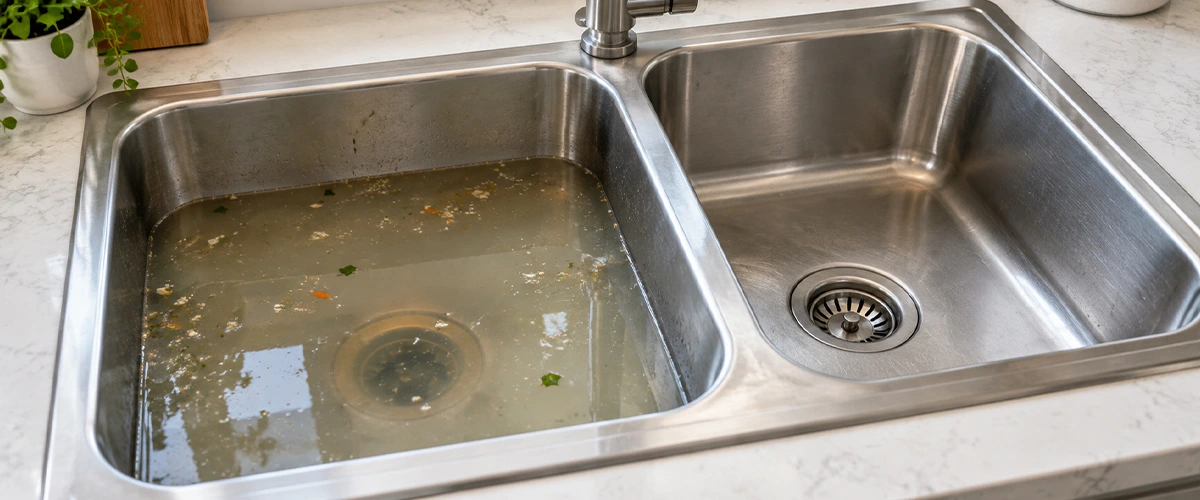
The dishes are done, and the plug is out, but the sink is still full of gray water an hour later. Or you run the garbage disposal, and the other basin starts to fill. When a kitchen sink backing up becomes a regular problem, the blockage is almost always in one of four places along the drain path. A jammed disposal, buildups in the P-trap, grease farther down the branch drain, or a problem in the main drain or sewer line. In this blog, we will discuss each of the four causes and the symptoms that go with it.
How Does Your Kitchen Drain Work?
A kitchen drain is a connected system. The sink basins, garbage disposal, and often the dishwasher all feed into the same drain path. When something restricts that path, the water looks for another way out. That is why the location of the backups matters more than the backup itself. Water that lingers in one basin points to a different problem than water that rises in the second basin or shows up in the dishwasher. What you see at the sink can point you in the right direction, but it can’t tell you exactly where the clog is.
Cause 1: Garbage Disposal Clogged
Food scraps, fibrous waste like celery or corn husks, and items that don’t belong in a disposal can jam the grinding mechanism or block its outlet. A garbage disposal clogged this way often hums without grinding, stops partway through a run, or trips its overload protection. Water may drain poorly while the disposal is running, and the sink may back up mainly when it is on.
These signs point towards the disposal, but they don’t rule out a blockage farther down the line. A disposal that can’t push water out may be struggling because something downstream is restricting flow. If the disposal keeps jamming, trips repeatedly, or the sink stays full, that is a job for garbage disposal repair by a professional.
Cause 2: P-Trap Clog
Under the sink, the drain pipe makes a U-shaped bend called the P-trap. The bend stays filled with a little water, and that water acts as a seal so sewer odors can’t drift up into the kitchen. Because of its shape, it is a natural place for food particles, soap residue, and grease to collect.
A localized trap blockage may show up as one basin draining slowly, or water staying in the sink even though the disposal runs normally. A slow kitchen sink drain often begins this way, with a partial blockage that lets water through, just not quickly. Still, those symptoms alone can’t confirm the trap is the problem. Confirming it may take a plumber looking at the trap and the connections around it. If the sink clears up and then slows down again a few days later, the cause is probably somewhere beyond the trap.
Cause 3: Branch Line Grease Clog
The branch line is the pipe that picks up where the P-trap leaves off and runs out of sight toward the main drain. Grease and food residue coat its walls a little at a time, and the passage slowly narrows. Common signs include:
- A slow kitchen sink drain that keeps getting slower from week to week.
- Repeated backups after earlier attempts to clear the sink.
- Water rising in the other basin when the disposal runs.
- Water backing up through the dishwasher connection or into the dishwasher.
- Several of these symptoms around the same drain.
The last two matter most. If water backs up into the other basin when the disposal runs, or into the dishwasher, the clog is likely past the trap, in the branch line. That is a different problem from a jammed disposal or a dirty trap, and it affects every fixture connected to that line. It does not prove the location in every home, since plumbing layouts differ, but it is a strong clue that needs confirmation. Continuing to run the disposal or dishwasher only pushes more water into a restricted pipe. Recurring buildup often calls for professional drain line restoration in Orange County rather than another short-term fix.
Hard Water and Drain Buildup
Grease and food waste can build up faster in hard-water areas. Mineral deposits can roughen the inside of pipes, which gives grease and food particles more to cling to. Hard water does not cause every clog, and its effects vary from home to home. But if your sink clears briefly and then backs up again, existing buildup may be part of the reason. Finding the actual restriction matters more than treating the same symptoms twice.
Cause 4: Main Sewer Line Backup
Sometimes the kitchen is not the real source. Warning signs that the trouble extends beyond the sink include:
- A second sink or drain in the house acting up at the same time.
- Water rising in a shower, bathtub, or floor drain when another fixture is used.
- Drains all over the house running slowly around the same time.
- Wastewater backing up in multiple areas.
- Gurgling sounds alongside other drainage problems.
These patterns suggest a shared drain, main drain, or sewer-line problem rather than an isolated clogged kitchen sink. If several fixtures are affected, especially if sewage is present, stop using them and contact a qualified plumber.
How to Tell Where Your Kitchen Sink Clog Is
Compare what you have noticed with the table below.
What You Notice | What It May Indicate | When to Call a Plumber |
Disposal hums or stops grinding | Possible disposal jam or appliance problem | If it remains jammed, trips repeatedly, or the sink stays backed up |
One basin drains slowly | Possible local blockage or P-trap buildup | If the water does not drain normally or the problem keeps returning |
The other side of the sink fills up whenever you switch on the disposal | Possible downstream restriction in a shared drain or branch line | If the backup persists or recurs, avoid repeatedly running the disposal |
Water backs up into the dishwasher | Possible restriction in the shared drain path or an issue at the dishwasher drain connection | Stop running the disposal and dishwasher and arrange professional diagnosis |
Multiple Fixtures Back Up | Possible shared drain, main drain, or sewer-line issue | Stop using the affected fixtures and call a plumber soon |
Signs You Need a Plumber for Your Kitchen Sink Backing Up
Professional help makes sense when:
- The sink repeatedly backs up after seeming to clear.
- Both basins are affected.
- Water backs up into the dishwasher.
- The disposal runs, but the sink keeps filling.
- Several fixtures are slow or backing up.
- There is a sewage or wastewater overflow, or a blockage with no clear cause.
- You can’t tell where the problem is.
If water is moving into connected fixtures, stop running the disposal and the dishwasher until the system has been assessed. Pushing more water into a restricted line tends to make the backup worse. Chemical drain cleaners are not a good default either, especially when water is standing in the sink or the blockage has not been identified. They may not clear the underlying restriction, and leftover chemicals can create a hazard for whoever works on the pipes next.
Professional Kitchen Sink Clog Repair
The most useful thing a plumber brings to a backed-up sink is an answer to “where is it?” Clearing the wrong section of pipe can leave the real blockage in place, and the backup returns a week later. Parzival Plumbing can evaluate whether the problem is in the disposal, the trap, the branch line, or farther along the drain system, then recommend the repair that fits. This kind of kitchen sink clog repair starts with diagnosis, not guesswork.
Final Thoughts
A kitchen sink backing up rarely fixes itself, and the path the water takes usually says more than the clog itself. A slow basin, water rising in the second sink, or water showing up in the dishwasher each points to a different part of the drain. Parzival Plumbing can inspect the disposal, the P-trap, and the branch line, and check whether other fixtures suggest a main drain or sewer line issue. From there, we recommend the correct sink closure repair that fits what we find. Contact our team to have the blockage located and addressed.
Frequently Asked Questions
Why does my kitchen sink back up when the garbage disposal runs?
Running the disposal sends extra water through the drain. If that water has nowhere to go, it can rise in the other basin. This often suggests a downstream restriction, such as in the branch line, though a plumber needs to confirm it.
Why is my kitchen sink draining slowly even when the disposal works?
A disposal that runs smoothly says nothing about the pipes after it. Grease, soap residue, and food particles can still narrow the P-trap or branch line. A slow kitchen sink drain that keeps getting worse usually points to buildup.
Can a clogged kitchen sink affect the dishwasher?
Yes. Many dishwashers share the sink’s drain path, so a restriction there can push wastewater back toward the dishwasher. It can also point to a problem at the dishwasher’s drain connection.
How can I tell whether a kitchen sink clog is in the P-trap or farther down the drain?
Symptoms offer hints, not certainty. One slow basin suggests a nearby clog. Water rising in the other basin or the dishwasher suggests one farther down. A plumber can confirm which it is.
When should I call a plumber for a kitchen sink backup?
Call when backups keep returning, both basins are affected, water enters the dishwasher, or other fixtures are involved. Sewage or an unclear cause is also reason enough. If you can’t tell where the problem is, professional diagnosis saves guesswork.